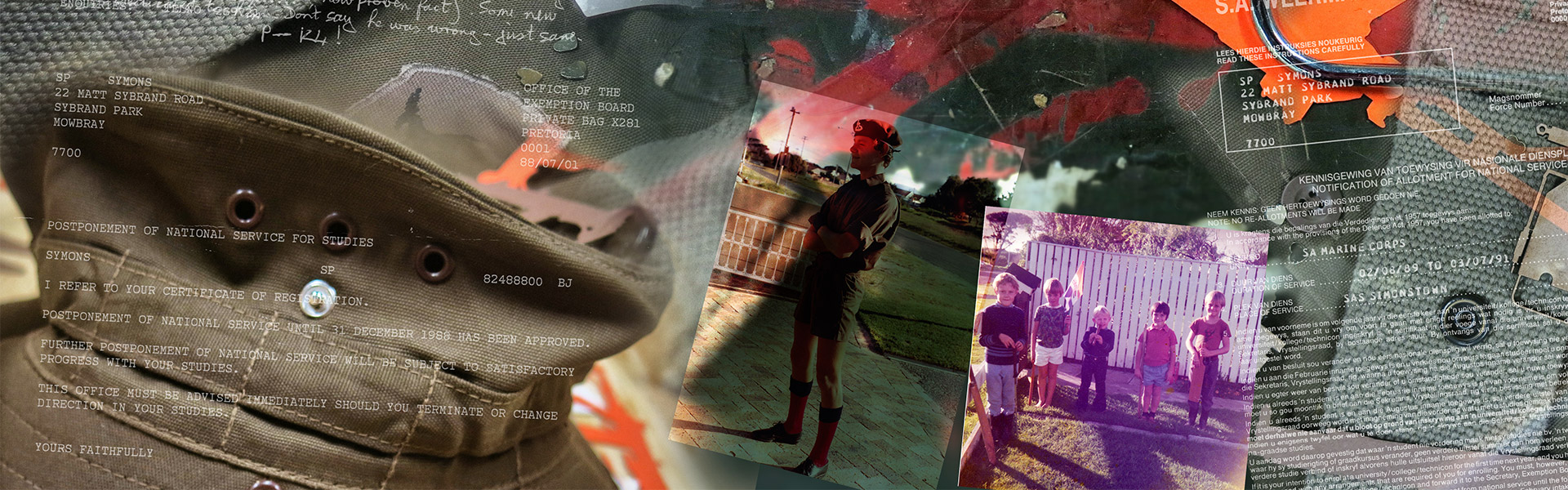
An excerpt from: ‘Casting Shadows’: Militarised boyhoods in apartheid South Africa during the 1980s
Childhood, 2020, Vol. 27(4) 514–529, Copyright: The Author(s) 2020,
Article reuse guidelines: sagepub.com/journals-permissions | DOI: 10.1177/0907568220922877 | journals.sagepub.com/home/chd
Abstract
This article provides a series of insights into the structures and scaffolding of militarising White South African adolescents during the 1980s, including the processes of militarisation from childhood up until induction into the former South African Defence Force. Although this article traces the process and presents personal accounts of militarised childhoods, it ultimately questions how these indeterminate memories attempt to navigate a contested present, namely, a post-apartheid space.
Keywords
Apartheid, conscription, counter-memory, masculinities, memory, militarisation, nostalgia, South African Defence Force, Whiteness
Introduction
It is estimated that 600,000 White males were conscripted from South African society between 1968 and 1993 (Williams, 2008). This prompted the evolution of a complicated socialised obligation towards conscription, bolstered by an oppressive political and military regime. This article provides a series of insights into the structures and scaffolding of militarising White South African children during the 1980s, up until induction, as adolescents, into the former South African Defence Force (SADF).
I will point to the defining moments of the process of militarisation, originating in childhood, and suggest that the state relied on the tacit compliance of Christian National Education (CNE) and immediate family structures for the effective formation of militarised masculinities within apartheid South Africa of the 1980s. This period includes both the apogee and decline of the regime’s political and military machinery, marked by demonstrative public opposition towards the SADF and the apartheid regime (Baines and Vale, 2008; Cock, 1991; Cock and Nathan, 1989). Black resistance within the borders of South Africa had reached a critical mass by the mid-1980s (Cock and Nathan, 1989). Organisations such as the United Democratic Front (UDF), trade unions,
uMkhonto we Sizwe (the military wing of the African National Congress) and whole communities posed a severe risk to internal security, forcing an over-stretched police force to rely on the SADF for assistance.
Although this article traces the process and presents personal accounts of militarised childhoods, it ultimately questions how these indeterminate memories enter and attempt to navigate a contested post-apartheid space. I argue that these memories assume the guise of counter-memory, often infused with a deep sense of nostalgia. Here, I rely on George Lipsitz’s (1990: 213) concept of counter-memory, which unearths the past, exposing ‘hidden histories’ that have been excluded from dominant narratives, and Svetlana Boym’s (2001) notion of nostalgia of a longing for a home that has ceased to exist or has simply never existed. Allied to Melissa Steyn’s views on ‘centralized’ Whiteness and Daniel Conway’s research on the militarisation of South Africa during apartheid, I argue that militarised childhoods and their related narratives tend to seed counter-discourses and memorialisations within a vastly altered present-day South Africa, specifically in the case of ex-conscripts who remain an influential minority within post-apartheid South Africa.
Dr Stephen Symons
Department of Historical and Heritage Studies
University of Pretoria, South Africa